




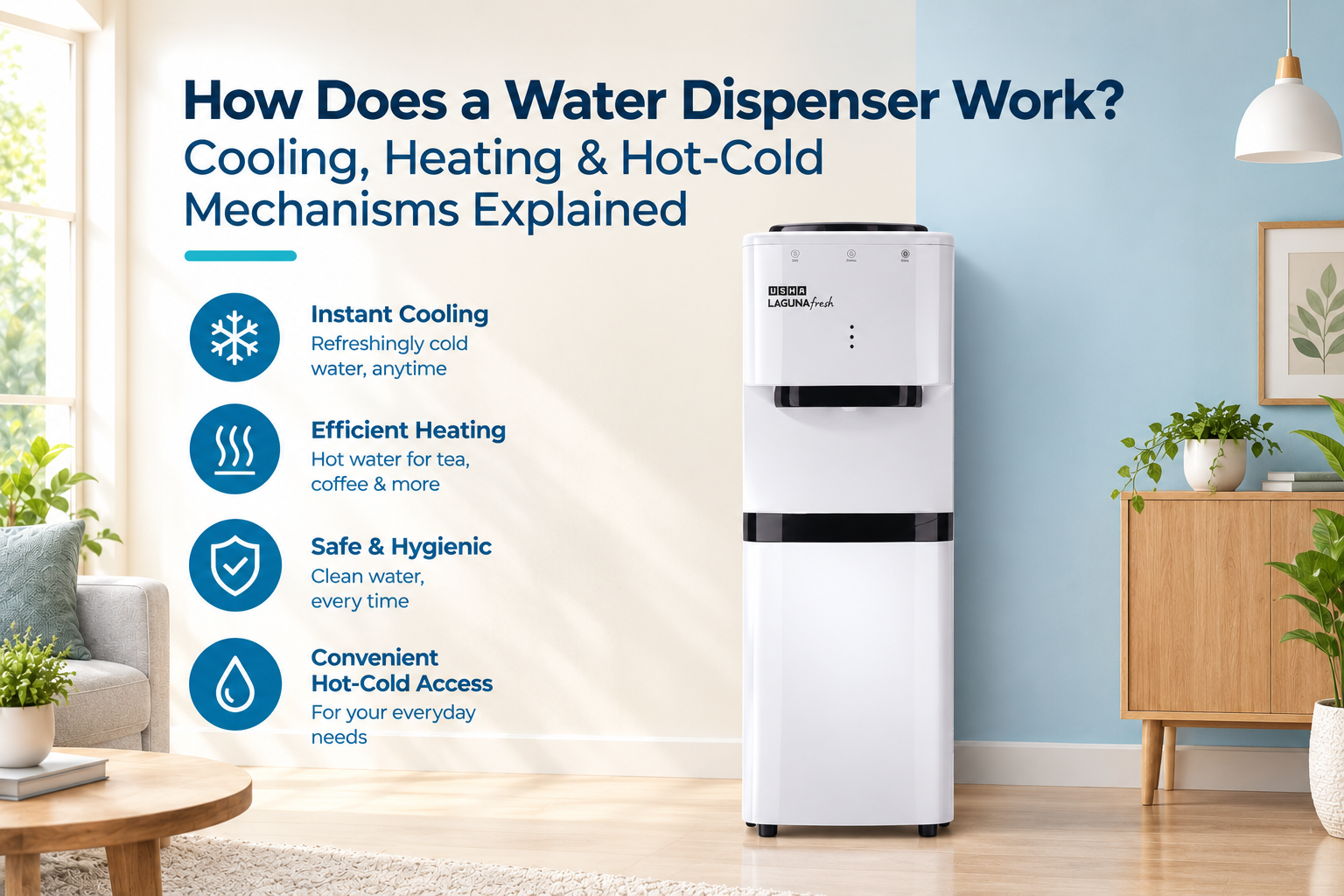
How Does a Water Dispenser Work? Cooling, Heating & Hot-Cold Mechanisms Explained
From dispensing water at room temperature to providing it hot or chilled, modern water dispensers use different mechanisms to deliver water at the desired temperature. Understanding how these heating and cooling systems work can help you make better sense of the features and functions offered by different types of water dispensers.
Usha offers a range of efficient water dispensers, such as the USHA Laguna Fresh Water Dispenser, to suit different needs. These water dispensers feature reliable compressors and water storage tanks for optimal performance.
But have you ever wondered how a water dispenser works to provide you with hot or cold water? This guide will help you understand.
What is a Water Dispenser and What Does It Do?
A water dispenser is a convenient appliance designed to provide drinking water whenever needed. Depending on the type and model, it can dispense normal, hot, or cold water, making it useful for homes, offices, and other everyday settings. Water dispensers are available in different configurations, including top-load and bottom-load models, to suit different spaces and usage requirements.
But how does a water dispenser work? The appliance draws water from its connected source or bottle and delivers it through a dispensing mechanism. Models with heating and cooling functions use dedicated systems to adjust the water temperature, allowing users to access hot or chilled water with ease.
Types of Water Dispensers
Some of the commonly available types of water dispensers include:
| Type of Water Dispenser | What It Does |
|---|---|
| Hot and Cold Water Dispenser | Dispenses both hot and cold water, in addition to normal water |
| Instant Hot Water Dispenser | Dispenses hot water only |
| Bottom-Load Water Dispenser | Uses a water bottle stored at the bottom, making it easier to load and replace |
| Top-Load Water Dispenser | Uses a water bottle placed on top of the dispenser to supply water |
The Basic Working Principle of a Hot and Cold Water Dispenser
A hot and cold water dispenser uses separate heating and cooling mechanisms to provide water at different temperatures as needed. But how does it work? Keep reading for more insights.
How Does a Water Dispenser’s Cooling Mechanism Work?
The cooling mechanism of a hot and cold water dispenser relies on a compressor-based system, similar to a refrigerator. In addition to the compressor, the system has other parts like a condenser and evaporator.
A liquid refrigerant moves through the system, absorbing heat from the water. Then it releases it outside and lowers the water’s temperature. The chilled water is then stored in an insulated tank and is ready for use.
Usha’s hot and cold water dispensers use a reciprocating compressor for long-term use. They also feature cold water storage tanks with capacities ranging from 3L to 3.2L, depending on the model.
How Does a Water Dispenser’s Heating Mechanism Work?
A water dispenser's heating mechanism depends on the heating element it uses. When you turn on the dispenser, the heating element heats the water.
This heating element has a temperature-sensing device, like a thermostat, that shuts off the heating element once the water reaches the temperature the manufacturer sets.
After that, the heated water is stored in its respective tank and ready for use.
How Does an Instant Hot Water Dispenser Work?
An instant hot water dispenser uses a quick-heating element to heat the water. When cold water enters its chamber, it flows over the quick-heating element. The heating element heats the water to the desired temperature, then dispenses it through the nozzle.
How Does a Bottom-Load Water Dispenser Work?
When you press the bottom-load water dispenser’s dispense button, the pump inside the storage cabinet generates air pressure. This creates a vacuum and suction in the U-shaped tube attached to the water bottle in the bottom cabinet.
The suction force pulls water from the bottle toward the water-dispensing faucet.
Choosing a USHA Water Dispenser for Your Needs: What to Consider?
Consider various factors before choosing your preferred Usha water dispenser. These involve:
Home or Office Use and Tank Capacity
First, decide whether you need a water dispenser for office or home use. An office water dispenser should have a higher tank capacity than a home one because commercial spaces use more water.
Usha offers water dispensers with tank capacities ranging from 3L to 4.2L, depending on the model. For example, the USHA Aquagenie+ Water Dispenser offers a 4.2L tank capacity, with 3.2L cold water storage and 1L hot water storage. It is ideal for home usage, and for small workplaces.
Type of Water it Provides
The type of water the dispenser provides matters. A dispenser that provides both hot and cold water, for example, can help fulfil your needs during the changing seasons.
Usha understands this need and offers various hot and cold water dispensers for your use.
Water Storage Tank Type
A water dispenser’s tank determines the quality of water which it stores. Usha’s water dispensers, like the USHA Laguna Fresh Water Dispenser, feature a high-quality stainless steel tank and other components for safe water storage.
Additional Features
Water dispensers generally dispense hot and cold water, or either hot or cold water. Usha’s water dispensers go the extra step by providing additional features like cooling cabinets for storing beverages.
For example, the USHA Instafresh Water Dispenser features a 20L cooling cabinet for storing beverages.
Power Consumption
A water dispenser with reduced power consumption can help lower electricity bills. At Usha, we ensure that our water dispensers, like the USHA Instafresh Water Dispenser, reduce electricity consumption with advanced cooling systems. These systems utilise less electricity to cool the water.
Maintenance
Choosing a low-maintenance water dispenser ensures stress-free ownership. Usha’s water dispensers, like the USHA Aquagenie+ Water Dispenser, feature a tough, corrosion-resistant ABS body, so you don’t have to worry about any degradation.
Conclusion
Knowing how a water dispenser works helps you understand how it delivers water at different temperatures and choose the right type for your needs. From hot and cold dispensers to top-load and bottom-load models, each type offers a convenient way to access drinking water.
At USHA Water Solutions, we offer a broad range of water dispensers to suit varying needs and preferences. Explore the available options on our website or visit a nearby USHA store to find the right dispenser for your home or workplace.
Frequently Asked Questions
Q.1 Do Water Dispensers Work Without Electricity?
Ans: No, water dispensers rely on electricity to run normally. Usha’s water dispensers, like the USHA Instafresh Water Dispenser, feature efficient cooling systems that use less power.
Q.2 What Is the Power Consumption of a Water Dispenser?
The power consumption of a Usha water dispenser depends on the model, its wattage rating, and how often you use the heating or cooling functions. For detailed information, you can visit our website or a nearby Usha store.
Q.3 How Do You Maintain a Water Dispenser?
You can maintain a water dispenser by cleaning it regularly, replacing the bottle if needed, using clean water, draining and flushing the system, and storing the dispenser in a cool, well-shaded area with adequate ventilation.
Also, don’t forget to have it professionally inspected or serviced once a year by a manufacturer-approved technician.
Q.4 How Does an Automatic Water Dispenser Work?
An automatic water dispenser uses electronic controls or sensors to dispense water with minimal manual effort. Depending on the model, it may also include heating or cooling mechanisms to provide water at the desired temperature.